Every few months, someone offers a hotel general manager a box that will "cut the electricity bill by 15%". Sometimes the box delivers. Often it delivers far less, and the hotel never finds out, because nobody measured properly.
Voltage optimisation is a real, well-documented technique. It is also one of the most oversold. The Institution of Engineering and Technology put it bluntly in its wiring guidance: applied incorrectly, it can be a waste of money. This guide explains where the saving in a hotel comes from, which of your loads respond and which do not, and how to write the saving into a contract so that it is measured rather than promised.
Why your hotel probably receives more voltage than it needs
In Europe, the low-voltage supply is nominally 230 V. The standard that defines supply quality, EN 50160, allows the 10-minute average voltage to sit anywhere between 207 V and 253 V for 95% of each week. That is a wide band, and grid operators have good reasons to run their networks in its upper half: voltage drops along every cable, so the transformer end is set high enough for the last customer on the feeder to still receive an acceptable value.
Measurements bear this out. In a large UK smart-grid study covering 828 substations and 3,609 feeder ends, 56% of the readings at substations and 38% at the customer end were between 243.8 V and 253 V. In the Netherlands, the grid operators' 2025 voltage-quality report found no breaches of the limits, but noted that both the highest and the lowest measured voltages have crept up since 2016, most likely because of rooftop solar. In Flanders, Fluvius received more than 5,100 complaints about voltage problems and tripping solar inverters in 2023, caused by local overvoltage on sunny days with low demand. Better grid management brought that down to around 2,200 in 2025, but the pattern behind it has not gone away.
Hotels sit squarely in this picture. Many are in city centres close to a distribution transformer, and more and more of them have solar panels on the roof that push the local voltage up exactly when the sun is out.
How voltage optimisation saves energy, and the physics that limits it
Equipment rated for 230 V does not need 245 V. For some loads, the extra voltage is simply turned into extra power. A resistive element draws power in proportion to the square of the voltage, so a 1% voltage cut gives roughly 2% less power. Run a 230 V halogen lamp at 245 V and it draws around 10% more power than its rating, and burns out much sooner.
A voltage optimiser lowers and stabilises the supply voltage for the whole building, usually at the main low-voltage switchboard. The catch is that "the whole building" contains many loads that do not behave like a resistor. Utility trials of voltage reduction typically show between 0.3% and 1% less load for every 1% of voltage reduction, not 2%. The Carbon Trust's worked example, a 6% voltage cut that produced a 4.9% site saving, sits towards the favourable end of that range.
So the honest question is not whether voltage optimisation works. It is what share of your hotel's electricity goes into loads that respond to it.
Hotel loads that respond, and loads that don't
Here is how the main hotel loads behave when the voltage is brought down from the top of the band towards 230 V, based on guidance from the Carbon Trust, the Sustainable Energy Authority of Ireland (SEAI) and IEEE field studies.
| Load | Responds? | Why |
|---|---|---|
| Halogen and incandescent lamps | Yes, strongly | They behave like resistors: power falls with the square of the voltage |
| Fluorescent and discharge lamps on magnetic ballasts | Yes | Typical of older back-of-house, car-park and corridor fittings |
| LED lighting, fluorescents on electronic ballasts | Little or none | The driver regulates the power itself |
| Fixed-speed fans, pumps and compressors, oversized or part-loaded | Yes | Magnetising losses fall with the voltage |
| HVAC, pumps and lifts on variable-speed drives | Little or none | The drive regulates the motor |
| Kettles, water heaters, ovens, electric heating | No | Thermostatic: they simply run a little longer |
| Laundry dryers and ironers (heating side) | No | Thermostatic, as above |
| Cold rooms and refrigeration without speed control | Partly | Depends on the compressor motor and how heavily it is loaded |
| TVs, IT, chargers, LED drivers | No | Switch-mode supplies draw the same power at a slightly higher current |
Two practical consequences follow. First, a hotel that has already moved to LED lighting and put its air handling units on variable-speed drives will save noticeably less than the same building ten years ago. The CIBSE energy performance group gives a feel for the range on lighting alone: up to 30% on switch-start fluorescent and discharge lamps, around 5% on high-frequency fluorescent, nothing at all on LED. Second, planned upgrades matter. If you intend to retrofit LEDs next year, compare that project with voltage optimisation before committing to either, because each one erodes the other's savings.
There are also three engineering checks that apply to hotels in particular:
- Lifts. Ask the lift manufacturer before the supply voltage is lowered.
- Motors. A 10% voltage reduction cuts the torque of an induction motor by about 19%. That is irrelevant for a lightly loaded fan and important for a motor already working at its limit.
- Electronic loads. If 30% or more of the load is switch-mode, check that cables and protection can carry the slightly higher current.
What saving is realistic for a hotel?
Independent sources converge on single-digit to low double-digit percentages. The New South Wales government's guide, one of the more balanced references on the subject, speaks of savings of up to 12% where much of the equipment is voltage-sensitive, while warning that some sites save little. Figures quoted by the industry usually span 5% to 13%, with higher numbers only on sites that combine a high supply voltage with old lighting.
The way a hotel uses electricity explains why the spread is so wide. European hotels typically consume 200 to 400 kWh per square metre per year, with no significant difference between star ratings. Heating, cooling and ventilation take around half of that energy and lighting 12–18%, rising to 40% in some buildings. Electricity makes up roughly 40% of the total, and before the LED era lighting alone accounted for almost half of the electricity. Every lighting retrofit since then has shifted the balance towards loads that respond less.
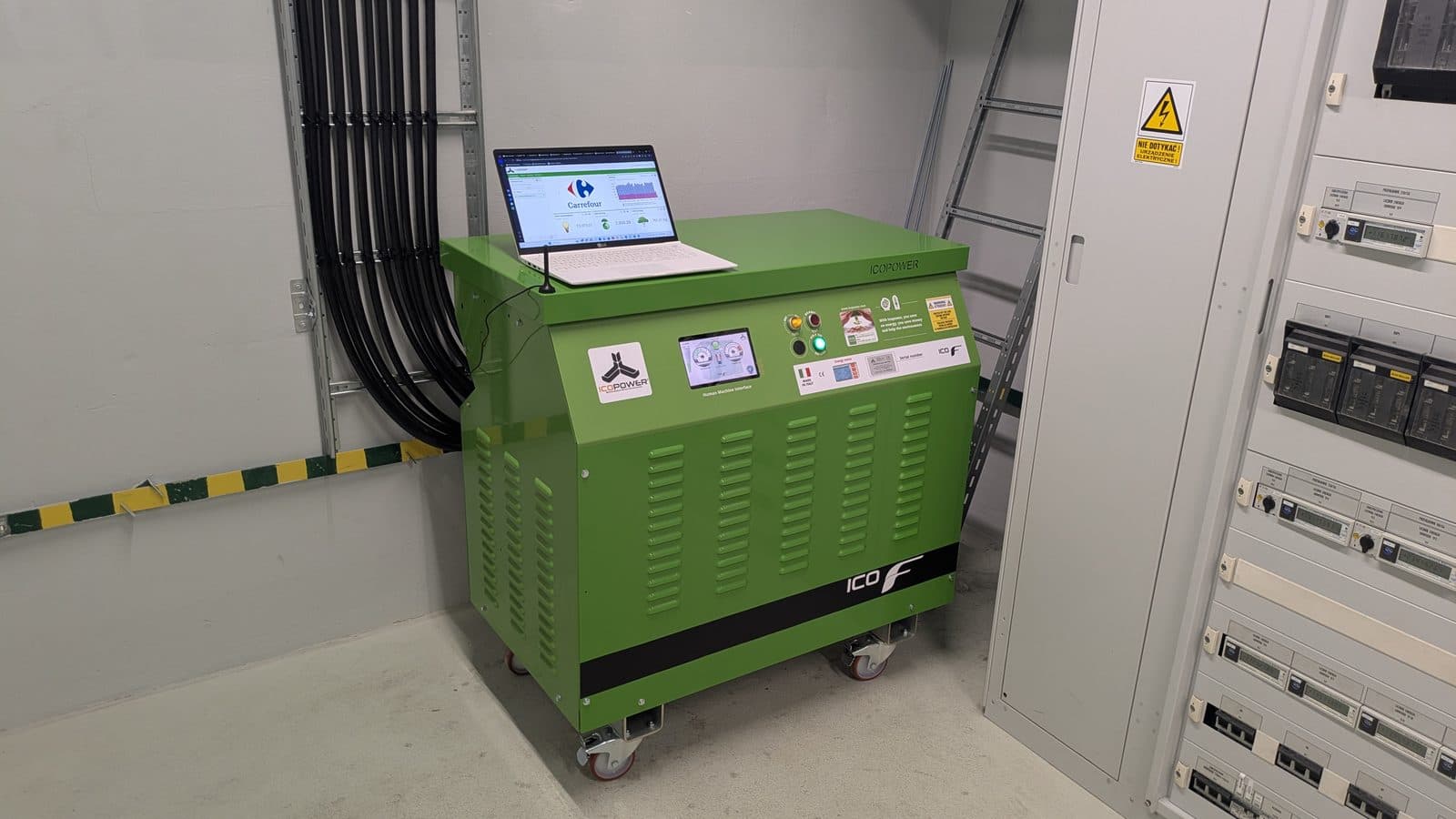
At Enthrust Energy we write a saving of 5–9% of active energy into the contract for our ICO-F voltage optimisation systems, and only after a site survey has shown that the load mix supports it. If the measured saving falls short of the agreed figure, we pay the difference. That arrangement only works if the measurement is sound, which brings us to the part most offers skip.
A worked example: what 5–9% is worth
Take the 100-room hotel with a pool that the European Commission's Joint Research Centre uses as a reference case in its best-practice report for the tourism sector. It consumes around 2,390 MWh of energy a year. If 40% of that is electricity, the hotel buys roughly 950 MWh of it.
Eurostat put the average electricity price for Belgian non-household customers in the 500–1,999 MWh band at €0.187 per kWh in the second half of 2025, excluding VAT and recoverable taxes. At that price, the hotel's electricity costs about €177,000 a year. A 5% saving is worth roughly €8,900 a year, and 9% is worth about €16,000. Smaller hotels in the 20–499 MWh band pay more per kWh, €0.216 in Belgium and €0.246 in the Netherlands over the same period, so every kWh they save is worth more.
These are illustrations, not quotes. What they show is that on a bill of this size, the difference between a real 5% and an imagined 12% is more than €12,000 a year. The percentage on the brochure matters far less than whether anyone measures it honestly.
Proving the saving: IPMVP in plain words
The International Performance Measurement and Verification Protocol (IPMVP) is the reference method for showing that an energy saving is real. It offers several options, and two of them suit voltage optimisation.
Option A measures the one parameter that drives the saving and agrees the rest in advance. For voltage optimisation that usually means measuring the power drawn by the affected circuits with the optimiser in service and then in bypass, while values such as operating hours are fixed in the contract. It is cheaper, and accurate enough when the measurement boundary is drawn sensibly. SEAI's template for voltage optimisation follows this approach: the boundary goes around the voltage-dependent loads, and the result is cross-checked against the normalised main-meter data.
Option B meters all the energy used by the affected system before and after, with nothing assumed. It costs more and is more precise.
What does not work well is the shortcut many suppliers prefer: comparing this year's bills with last year's. That whole-facility approach, Option C, is suited to savings above roughly 10% of site consumption with monthly data, or above 5% with daily data. A 5–9% saving sits right on that threshold, and in a hotel the noise from occupancy, weather, events and the restaurant's opening hours can easily hide the saving, or flatter it. Where heating and cooling vary with the seasons, SEAI recommends a baseline of at least six months.
A checklist before you sign
- Log the voltage at the main low-voltage switchboard for at least one to two weeks, in 10-minute averages. If it already sits close to 230 V, there is little to optimise.
- Make a load inventory: lighting by technology, motors with and without variable-speed drives, thermostatic loads, the kitchen and the laundry.
- Tell the supplier about planned upgrades, such as LED retrofits, new chillers or heat pumps, and ask how the guarantee treats them.
- Insist on an automatic bypass. A voltage optimiser sits in series with the whole building, so it must never become a single point of failure. Our ICO-F units switch to bypass automatically, within milliseconds, if anything goes wrong.
- Check lifts and large motors with their manufacturers.
- Put the measurement plan in the contract: the IPMVP option, the measurement boundary, the baseline period and how the baseline is adjusted when occupancy or the building changes.
- Ask what happens if the saving falls short. "Up to 15%" in a brochure is not a guarantee.
Where else hotels lose money on electricity
Voltage is not the only power-quality issue in a modern hotel. Variable-speed drives, LED drivers and IT equipment distort the current with harmonics, and a building full of motors and electronics can also run a poor power factor. Neither problem shows up as kWh on the bill, but both heat cables and transformers, and in some tariffs reactive energy is charged directly. A static VAR generator with active harmonic filtering deals with both. If you are logging the voltage anyway, have the analyser record harmonics and power factor during the same week: the extra data costs almost nothing.
To see measured results from comparable sites, including food production and cold storage, look at our case studies. And if you would like us to go through your voltage log and load inventory with you, get in touch.